

.svg)


December 8, 2023
What Tests Must UN-Certified Bulk Bags Pass?
What Are UN-Certified Bulk Bags? A UN-rated FIBC bag is a flexible intermediate bulk container also known as a bulk bag or big bag. It has been..
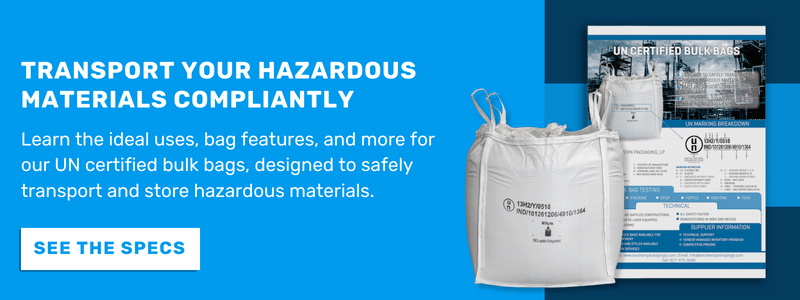
Transporting hazardous materials in a safe and legal manner requires the use of UN-certified packaging. FIBCs intended to carry hazardous materials must have the proper UN markings, which are made up of various letters, numbers, and symbols with specific meanings. We stock over 1,000,000 UN-certified bulk bags available for immediate shipment.
UN-Certified packaging refers to packaging that has been tested and certified to meet the requirements of the United Nations (UN) for the safe transportation of dangerous goods.
The UN certification process ensures that packaging is capable of withstanding various conditions and protects its contents during transport, including potential hazards such as shock, vibration, compression, and temperature changes.
The certification process involves subjecting the packaging to various tests, including drop tests, stacking tests, pressure tests, and penetration tests, among others. The packaging must meet certain performance standards, such as the ability to prevent leaks and resist damage during transport.
UN-certified packaging is essential for transporting hazardous materials safely and legally. The use of UN-certified packaging is mandatory for the transport of dangerous goods by road, rail, sea, and air.
Request a Quote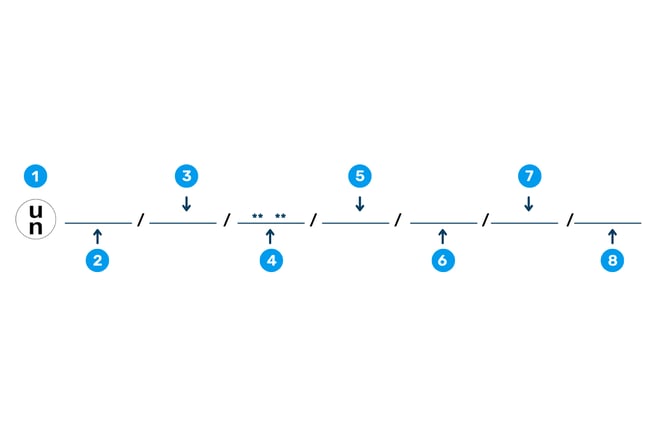
Each flexible intermediate bulk container (FIBC) intended for hazardous materials or dangerous goods packaging must be marked as follows:
1. The UN packaging symbol
2. The designation code for the type of packaging:
3. A capital letter indicating the approved packing group(s) for the design type:
4. The manufacture date, indicated by the month and year (last two digits)
5. The state responsible for authorizing the allocation of the mark, which is identified by the distinctive symbol for motor vehicles in international transportation
6. The manufacturer's name or symbol and other identifying information of the FIBC, as specified by the relevant regulatory authority
7. The stacking test load in kilograms (kg); for FIBCs not designed for stacking, a “0” must be inserted
8. The FIBC's maximum allowable weight, including its contents and the weight of the bag itself, in kilograms
The markings must be placed in a visible location and remain legible throughout the life of the FIBC. Moreover, they should be at least 12 millimeters (mm) tall, including letters, numerals, and symbols.
.jpg?width=480&height=320&name=Stacking-BulkBags-Canva%20(1).jpg)
Every UN-certified FIBC must display the UN symbol clearly, whether or not it's designed for stacking. Requirements include:
Bags not designed for stacking must show a "0" in place of a stacking load value.
UN markings must be placed in a clearly visible location on the FIBC and remain legible throughout the life of the bag. The markings - including letters, numbers, and symbols - must be at least 12 millimeters tall.
The code 13H4 identifies a flexible intermediate bulk container (FIBC) made from coated woven polypropylene with a factory-installed liner. The “13” designates flexible bulk containers, “H” indicates woven plastic construction, and “4” indicates the coated-with-liner variant. Other codes in the series are 13H1 (uncoated, no liner), 13H2 (coated, no liner), and 13H3 (uncoated, with liner).
UN markings are typically preprinted during manufacturing to ensure durability and legibility. The markings are part of the certified design type - they cannot be retroactively applied to a non-certified bag to make it compliant. The bag must have been tested and certified as the specific design type indicated by the marking.
To ensure compliance with relevant regulations, it is necessary to use placards or labels that correspond to the specific product being transported in the FIBC. To determine the exact placard and label requirements, refer to the applicable regulations and guidelines.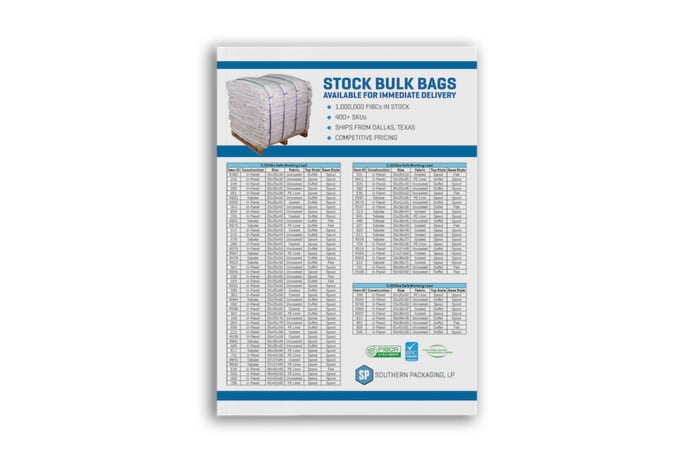
To ensure compliance with relevant regulations, it is necessary to use placards or labels that correspond to the specific product being transported in the FIBC. To determine the exact placard and label requirements, refer to the applicable regulations and guidelines.
Southern Packaging, LP stocks over 1,000,000 bulk bags available in hundreds of sizes and styles. Our UN-certified bulk bags are preprinted and ready for immediate shipment.
Contact our experienced sales team for more information.
Contact Us